

In high-variety format production environments, complexity does not break systems overnight.
It exposes gaps.
Most premade pouch lines are not designed as a single system.
They are assembled.
- Infeed
- Dosing system.
- Pouch feeder.
- Filler.
- Sealer.
- Checkweigher.
- Cartoner.
Each machine may perform well individually.
But performance is not additive.
It is systemic.
As format count increases, changeover frequency rises. Parameter resets multiply. Cleaning cycles expand. Synchronization between upstream and downstream becomes more critical.
In documented environments, low-volume variants have consumed close to 9–10% of total available capacity through changeovers alone. That erosion is structural. It increases under mix pressure.
When systems are loosely integrated, small mismatches amplify:
A slight dosing variation affects fill stability.
A minor indexing delay creates seal misalignment.
An upstream micro-stop propagates downstream.
Automation magnifies these effects.
Industry surveys indicate packaging equipment is frequently reported as more downtime-prone than other industrial systems. In highly automated but fragmented lines, stoppages cascade more easily because subsystems do not communicate effectively.
The financial impact is rarely visible in isolation.
Integration gaps do not appear on a specification sheet.
They appear in Effective Stable Throughput.
Rated speed remains constant.
But as changeover frequency increases and synchronization becomes more delicate, effective performance declines.
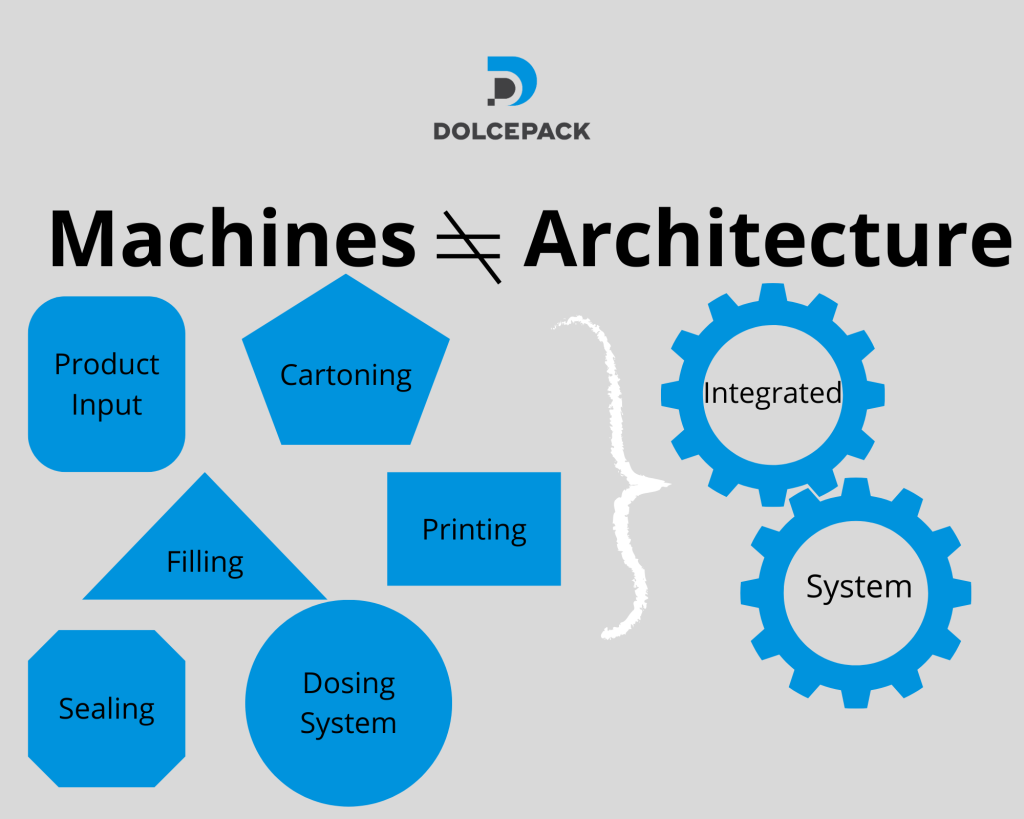
Integration, in this context, is not about connectivity alone.
It is about architecture.
Engineered changeover sequencing.
Balanced buffer strategy.
Aligned control logic between dosing and sealing.
Data feedback loops that reflect mechanical reality.
In complex environments, integration is a volatility management strategy.
It absorbs variability instead of amplifying it.
The strategic question is not:
“Are the machines advanced?”
It is:
“Are they engineered to operate as one system under high-mix pressure?”
In high-SKU production, ROI does not leak through mechanical failure.
It leaks through integration gaps.
Design the line.
Protect the investment.
Sources
• PMMI Industry Outlook Reports – system integration priorities in high-mix production
• VDMA Packaging Machinery Reports – modular architecture and flexibility trends
• Industry research documenting 9–10% capacity consumption from low-volume changeovers
• Packaging automation reliability surveys highlighting cascading stoppage risks in fragmented systems