

If your pouch line runs at 280 pouches per minute, is it optimized?
Or is it simply fast under ideal conditions?
Modern pre-made pouch systems can exceed 280 ppm. Automation promises efficiency gains of 15–20%. On paper, those numbers signal progress.
But premium food production is no longer defined by volume. It is defined by variability.
Branded manufacturers are expanding portfolios aggressively. Over the next five years, dozens of new SKUs will enter already crowded production schedules. As portfolios expand, batch sizes shrink. Changeovers increase. Format diversity widens.
In documented production environments, low-volume variants have consumed close to 10% of total available capacity through changeovers alone. That loss does not appear on a speed specification sheet. It compounds quietly.
- Rated speed measures output under ideal conditions.
- Stability measures performance under real conditions.
The difference between the two determines margin.
Scrap adds further pressure. Modern best-in-class packaging lines operate below 2.5% waste, with highly optimized facilities achieving under 1%. Yet when sealing instability or startup variability is not controlled, scrap and rework can approach 2% of annual revenue.
At higher speeds, minor instability has mechanical consequences. Film tension fluctuations create wrinkles. Synchronization drift weakens seals. Polymer bonding windows narrow. What is manageable at moderate speeds becomes magnified under format variability.
Automation alone does not eliminate this volatility. In many facilities, packaging systems are reported as more downtime-prone than other industrial equipment. In highly automated but poorly integrated lines, a minor upstream disruption can cascade into full-line stoppages.
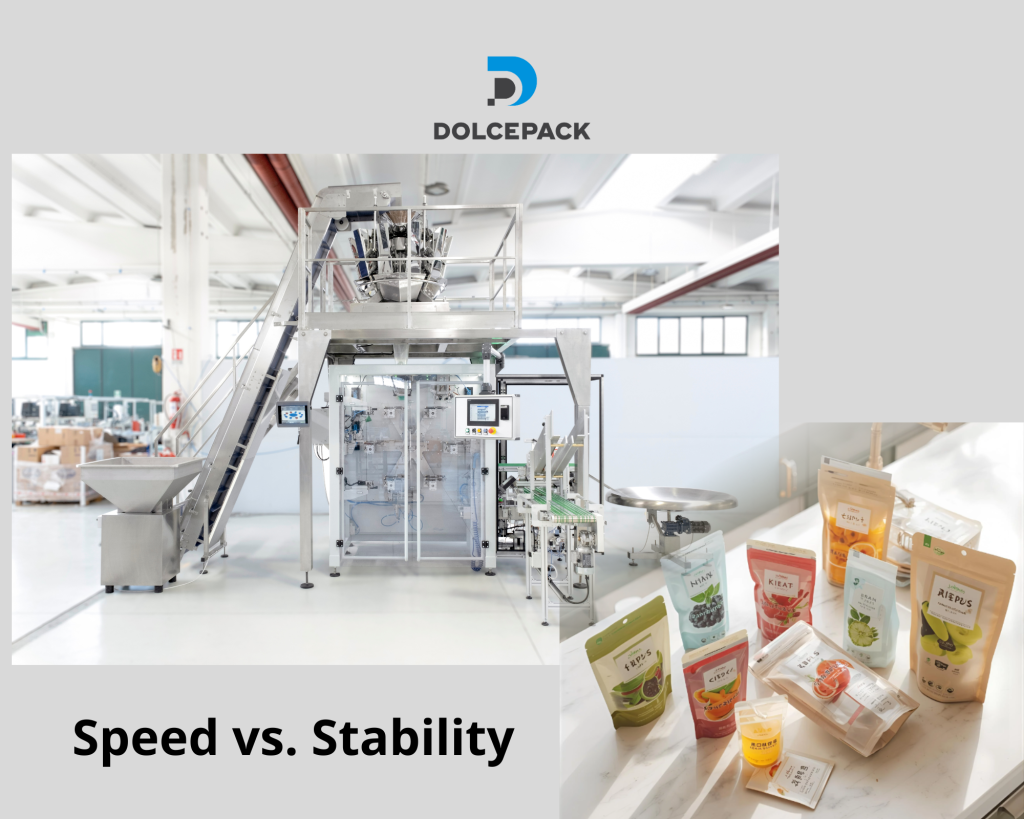
The strategic question for decision makers is no longer:
“How fast can the line run?”
It is:
“How stable is performance as SKU count increases?”
As portfolios expand and regulatory pressures tighten, production systems will increasingly be judged not by peak speed, but by sustained stability under variability.
Speed increases output potential.
Architecture protects investment.
Before your next capital decision, ask a harder question:
Is your line engineered for rated speed — or for SKU volatility over the next five years?
Design the line.
Protect the investment.
Sources
• Industry analysis on SKU proliferation and capacity impact in food manufacturing
• Seal integrity and scrap economics research
• Packaging automation reliability surveys
• EU food packaging waste and performance benchmarks